
The two square blocks bordered by Union and Lorimer Aves. and Devoe and Powers Sts. in Williamsburg are as pleasant a place as any to live in Brooklyn.
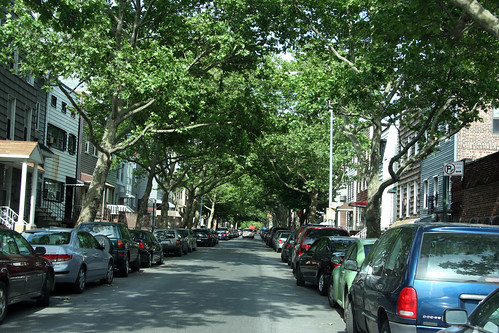
The streets are tree-lined and relatively quiet, yet only a short distance from everything Williamsburg has to offer.
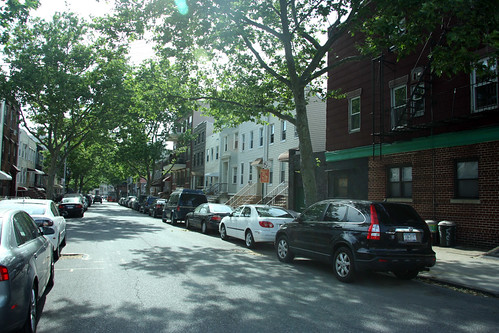
But the area wasn’t always residential. I was looking at the awesome 1849 map of Brooklyn on Hypercities when I noticed something very different. Here is the present street layout today:

But if you look on the 1849 map, you’ll see something very different:

A cemetery! That’s right, all you hipsters are living on top of a former burial ground once packed with corpses. Could your neighborhood get any cooler?
From what little information I could find online, this cemetery was once known as the Old Methodist Burying Ground. It was founded in 1835 (when the area was best described as “rural”) to service The Attorney Street Methodist Church in NYC and the First Methodist Protestant Church of Williamsburg. Ainslie Street (pictured below) once bisected the cemetery.
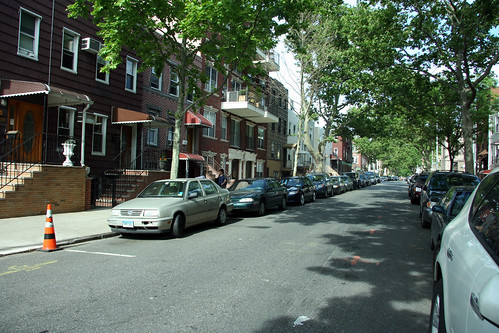
In 1856, the church closed the cemetery and the bodies were reportedly moved to Cyprus Hills Cemetery. At some point, an idea was either proposed or enacted to create a park on the former cemetery, to be named Freestone’s Burying Ground after the church’s undertaker, Thomas Freestone. Map-wise, the area appears to be residential by 1860.

Could a body (or two…or ten) still remain? No one knows for sure, but in researching this, I learned that the same Methodist churches later founded Union Cemetery in eastern Brooklyn. As the city limits stretched closer and closer, the proposition again arose to move the bodies out of Union Cemetery and sell the land. Union Cemetery was insanely over-crowded, with 30,000+ corpses (when they ran out of room, they simply began burying the newly deceased in old plots).
The idea of moving the bodies did not sit well with the cemetery’s families, however, who claimed that they owned the land their plots were on. The church conversely argued that they could do whatever the hell they wanted to with the bodies. This great NY Times article from 1893 describes the issues at hand, suggesting that money was of slightly more importance to the upset families than the actual location of the bodies. Take this quote from “chief of the macontents” Mr. Berger, when asked if he had a problem with moving the corpses:
“Fudge! They are only bones, so much rotten old bones! I don’t care a fillip (sic?) about them! What I want to know is whether there will be a surplus of cash after the removals are made and whether it will be divided among the plot holders.”
In the end, the bodies from Union Cemetery were moved in 1893 to Cedar Grove in Flushing. However, when they started transferring the remains, they found thousands more than were recorded. In other words: considering what happened at Union Cemetery, who knows what they might have missed the first time around in Williamsburg?
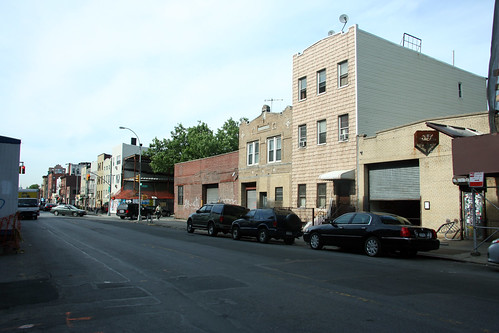
Amazingly, years later, a second graveyard would appear on the site of the Old Methodist Burying Ground: Barcade, a bar that better as a cemetery for old arcade games. Next time you’re playing Pacman and drinking a beer, remember that you might be standing over a corpse or two.
-SCOUT
Links:
NY Times (1893): Old Burying Ground Sold
Brooklyn Genealogy: Old Methodist Burial Ground
NY Family History: History of Union Cemeteries
Ancestry.com: General Defunct Cemetery Info
Full quote: Steve: You son of a bitch. You moved the cemetery, but you left the bodies, didn’t you? You son of a bitch, you left the bodies and you only moved the head stones. You only moved the head stones. Why? Why?
Idea to ponder: How many, if any, of those trees date back to the cemetery?

This is crazy. I wonder how they keep track of all the remains in transferring grounds and how many inaccuracies pop up? Who knows how many of us today are living on formerly sacred ground?
They did not keep records. At least that is what Cedar Groove will tell you. They have no idea how many or where in their cemetery the bodies were transferred to. It’s a little heart breaking to me. My great great grandparents were originally buries at Union Cemetery, and their final resting place is now lost to history.
I bet they have wonderful gardens, down there…
Scout,
Thought I would take a moment to let you know how much I love your blog. It brightens my day whenever you post something new.
Best,
-MAB
(Sometime Assistant Conductor, Riverside Choral Society)
Hm, that makes me want to start digging around for old maps of my area.
And I LOVE the Poltergeist reference. It fits perfectly!!
Damn! I kept wondering why my door never stays shut. I live on Ainslie in the middle of the old bone orchard. I have never experienced any ghost in my 4yrs here, but we do have a wonderful lush garden. Perhaps the gang of stray cats in my back yard are really lost souls trapped in hipster purgatory.
Is it just me, or is the wrong section highlighted in the first map? The cemetery was bounded by Union, Lorimer, Devoe, and Powers. The Google Maps screenshot has it bounded by Leonard, Lorimer, Devoe, and Powers.
No Alex, you must be seeing things….(just kidding, it’s fixed).
>>Idea to ponder: How many, if any, of those trees date back to the cemetery?
I don’t think that those trees are that old. I’d say they were planted in the 1960s. There was a huge tree planting push in the late 1960s/ early 1970s in many neighborhoods in NYC. I can remember as a kid many streets that are tree lined now being pretty barren back then. Even the block I had my first apartment on (20th st btw 8th & 9th) was pretty barren in the mid 1970s (although there were trees…they’ve just gotten bigger since then).
I always enjoy the blog, but I had to stop in with a special hat tip for the Poltergeist quote–I started reciting it even before I got to the end of the post, heh. Craig T. Nelson’s best work!
Fascinating. I just discovered your blog and now I’m hooked. I was born and raised in Williamsburg and lived there until last December when I moved to Bushwick. There’s so much I don’t know about these areas or NYC for that matter…
Pingback: Gamers and Ghosts: New York Video Game Bar Rests Atop Ancient Burial Ground « MUSEYON GUIDES
Pingback: Société Perrier » Blog Archive » BARCADE BUILT ON HAUNTED BURIAL GROUND
Besides of road having trees due to this can avoid pollution.This is very nice.
Pingback: FREEwilliamsburg » Barcade is Haunted! Built On a 19th Century Cemetery
I was launched by a friend to this website and it is simply awesome! Would like to share with the entire audience my favorite tv-series Bones as well as the spot I’m always enjoying it!
You are a very articulate blogger. This is a terrific website.
What I want to know is where is the list of names of the bodies moved? I may have two or more ancestors who have a new home in another cemetery.
Thanks for this article! I suspect I have at least one direct relative that was buried in the Old Methodist grounds. She died in Nov. 1849 and I know that she and her husband were both members at First Methodist. I have checked the available info on line for interments at Cypress Hills and her name isn’t listed. So, either they didn’t move all the bodies or they perhaps were buried, shall we say, without headstones in their new “digs”. If that’s the case, it may be that Cypress Hills won’t have any record of the individuals they accepted in their grounds. Thanks again, for giving me a clue about what became of great great great grandma. (Aren’t those old maps cool?!)
Brooklyn must have been absolutely lousy with cemeteries at one time, because just two blocks away from this article’s subject Methodist Burying Ground was yet another Union Cemetery, and that one bordered by Maujer (formerly Remsen), Stagg, Leonard, and Lorimer. It took forty years and the internet for me to finally verify one of the spooky scare tactics practiced on us kids by the faintly stiff (yet fun-loving) nuns of the now-defunct Immaculate Conception Parochial School in Williamsburg: “Did you know that our church (St. Mary’s, also now-defunct) and school were built on top of a cemetery!?” I suppose information of that sort was considered to be just another power-trip tool for scare ‘em straight nuns of the 60’s. But, hey! Even though I didn’t need the motivation, I still loved you gals. Hear that, Sister Asumpta? Get that, Sister Margaret Raine? So, just don’t come around and haunt me. Okay?
After MANY years of trying to find out my Maternal Great Great Grandmothers name I finally discovered who she was and now know where she was initially buried (although I still don’t know when she died) My Great GreatGrandmother was Caroline Donalson Ellis-Hewitt. She was told my Great Great Grandfather Edward Brewster Ellis had been killed in the Mexican War.in fact he was living in Maine in the First Federal Soldiers Home in Togus after having his arm blown off in an explosion on the Steamship “Iris”. Caroline then married Robert Hewitt a Widower she worked for who was originally from England and had a daughter Roberta. When my late Mother was given the Deed to the family Plot in Cedar Grove Cemetary Flushing Meadows…there is a list of all the Ellis’s intered and “two Unions”. Mom always thought..either Union Soldiers or Union of marriage. Through Ancestry.com I’ve learned from Robert Hewitts Descendants that they’d always “wondered” where Great Grandpa was moved to! Now they know…Woodbine Section Cedar Grove Cemetary Flushing Meadows! Odd ly enough..my Great GRandfather Edward Brewster Ellis Jr. was an Undertaker in Brooklyn!
Pingback: Paranormal Broketivity: an unofficial Brooklyn ghost roundup | Brokelyn
Please add me to your blogs.
I’m an old Billyburger myself born on 53 Ten Eyck and at 5 years old moved around the corner to 72 Stagg both between Leonard and Lorimer until 1968 when I was 18 and moved. My heart remains with Williamsburg and am still good friends with my best friend at 5 years old who lived on the corner of Lorimer and Stagg.
Doing a trip there soon with this best friend to visit our old stomping grounds as soo as the weather breaks. Thanks for the history, I’m a buff of History.
Frank Compoccio
I live on Lorimer & Powers start & had paranormal investigators check out the house. We had late night sightings of an Indian squaw walking around, and a mediam told us a woman & her two children died in a fire in the house. Problem is the house wasn’t there, they may still be buried beneath the house
Don’t know if anyone has visited the ‘Union’ section of Cedar Grove recently, but it is a deplorable mess with garbage all over the place, stones toppled every which way, and a mound of debris piled in one corner – on top of an old grave, no less. My great great grandparents, Thomas and Mary McCoy, were part of the ‘involuntary migration’ from Union in the late 1800’s but Cedar Grove has no record of either of them. We did find Thomas McCoy listed as removed from Union and reburied at Cedar Grove on a list compiled by the New York Genealogical and Biographical Society of the Methodist Protestants and The Union Cemeteries of Brooklyn. Problem is Thomas’ burial date is listed as 27 June 1864, which was actually his wife, Mary’s, burial date. Thomas died around 1850. Sloppy record keeping all around. I still can’t believe they got away with what they did back then.