
When I was a little kid, seeing two abandoned buildings like these would have set my imagination racing. I would have killed to go inside and explore their secrets.
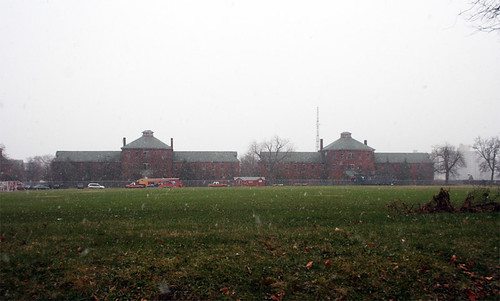
What would I find on the other side of boarded up doorways, broken windows, and crumbling brick walls? What sort of decaying furniture and forgotten relics would be waiting inside?
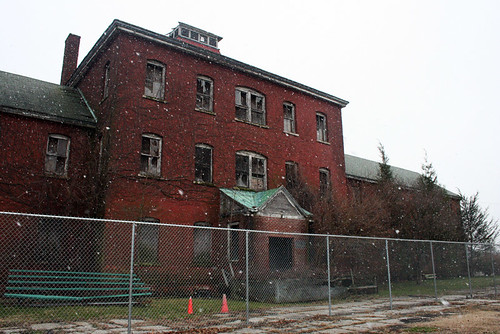
Who lived here? Who died here? Who still remains?
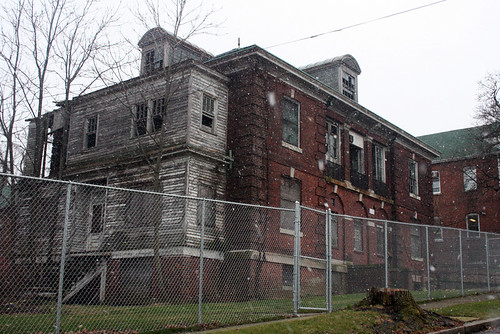
Some of you native New Yorker readers have probably identified the above as buildings located in Fort Totten park in Queens. Fort Totten is an old army base that dates back to 1850’s, located on a peninsula near Bayside. Its original purpose was to protect the East River approach to New York Harbor. It’s certainly no secret, but its distance from Manhattan, along with limited public transportation, make it something that might come as a suprise to many New Yorkers.
The park grounds were opened to the public in 2005, and you can now go and explore the 49.5 acre property, which features beautiful historic buildings, great expanses of open grass, and fantastic views of Long Island Sound and the Throg’s Neck Bridge. In the summer, you can even go on tours of the old stone battery (a mandatory field trip for every single elementary school student in all five boroughs of New York City).
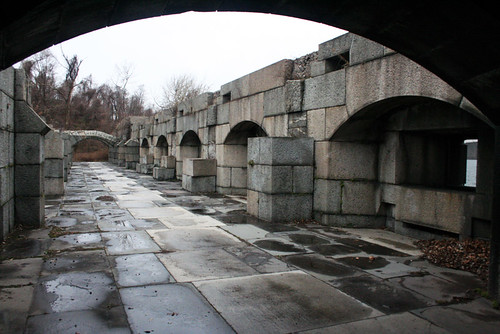
Over the past few weeks, I have had the rare opportunity to visit a number of abandoned buildings that are normally off-limits to the public, including some beautiful old science laboratories and hospitals, and I think my love for abandoned property has been completely beaten away. I don’t see hidden secrets and mysteries when I visit these places. I see them for what they really are: once beautiful, vibrant buildings that have been left forgotten to die a slow, painful death. I’m beginning to find it hard to stomach.
Take, for example, the old Willet Farmhouse (which I assume dates back to before the fort was built).
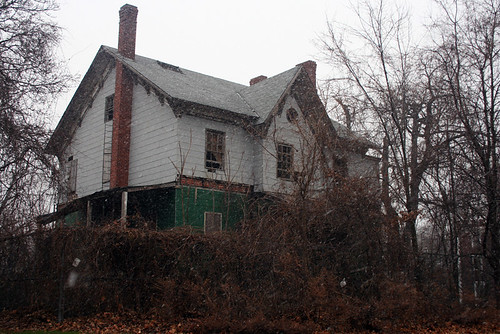

That’s right – there’s a fucking farmhouse in Queens. A big sign on the other side of this house reads “Please Excuse My Appearance! I Am A Candidate For Historical Preservation.” A candidate? How is there even a question?? When this is gone – when ANY of these buildings are gone – they are gone forever. They’re not coming back. You can always build another fifty-story glass-curtain high-rise, or a box-shaped three-story condo. But when the Willet Farmhouse finally collapses, that’s it. It’s a ghost.
Don’t get me wrong – I realize the financial realities that plague historical preservation (as the owner of an abandoned hospital outside of the city recently put it, “We can fix it up for $30 Million, or bulldoze it for $1 Million”). But there is an inherent timeless aspect of these properties that is priceless, which is why I was so uplifted when I saw Fort Totten’s former Officer’s Club, which was restored by the Bayside Historical Society:
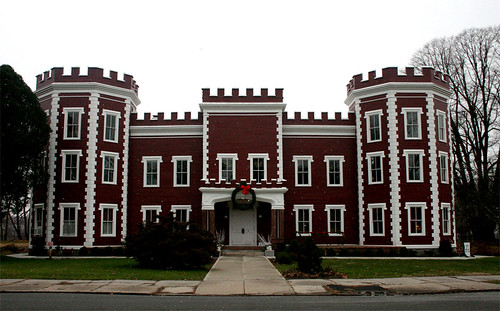
You simply can’t argue with it. This is what every building in the park should look like. Or check out the Parks Department headquarters:
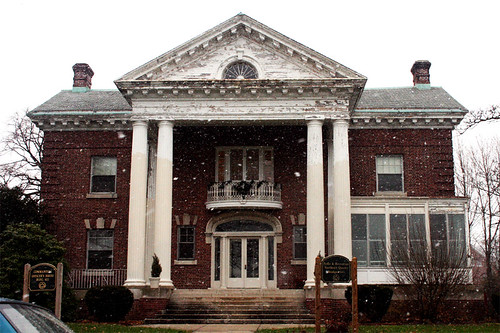
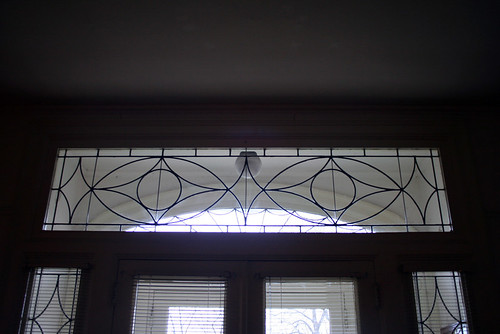
There is so much beauty to this building, from the columns and second floor balcony to the sunroom on the right and fantastic design in the glass above the doorway:
This is the Bachelor Officer’s quarters, which has also been restored:
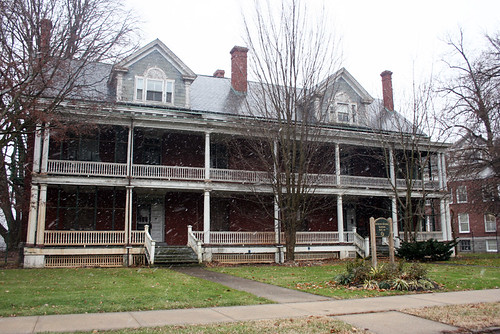
Can you imagine sitting on that porch on a warm summer evening?
There are some people in this world who get it, and the Parks Department control of these properties essentially guarantees that they are all safe from the bulldozer, a big Step 1 in keeping them around. I find this to be incredibly relieving after my recent trips to abandoned sites that will all probably suffer a mysterious fire at some future date.
Step 2, restoration, unfortunately requires money, and right now, it’s not a good time to be using the city funds for old, decrepit buildings. You can see the current projects on their capital page here. Among others, $65,000 has been allotted for Structural Investigation of the Willet Farmhouse, which is really good news (especially as other Queens farmhouses get covered in stucco siding by fucking idiots).
Anyway, I had a fantastic time walking around Fort Totten, and I really recommend it for a Saturday afternoon activity, especially for you photographers who love abandoned, decaying properties (don’t worry, I don’t hold it against you!). While the summer is probably better, there’s something wonderful about it on a snowy winter day.
More information can be found on the Parks Department website here, but you can take either the Q13 or Q16 bus to the end of the line (Fort Totten Stop – might want to study the Queens bus map for a better idea). I know it gets tiring to hear, but there’s a really good change that some of this won’t be there when you go to visit.
-SCOUT

I grew up near Ft. Totten – friends on the base used to tell me one of the homes that appears in the title sequence of the film Gone With The Wind was filmed there. Maybe it’s just local legend, but perhaps worth asking the historical folks if it’s true.
I live in a mostly rural area of PA, & I see farm houses & gorgeous old barns just crumbling into the ground, & it breaks my heart. What a waste of incredible craftsmanship & history. There are some barns that have been restored into gorgeous homes, & companies that dismantle the barns to erect them elsewhere, but the majority go to waste. Shameful that so much history all over this country is left to rot.
Thanks for reminding me that I have to get back to the Furmanville Farmhouse and assess the damage…
Great shots of the Fort.
FYI, Fort Totten was designated a NYC Historic District in 1999. The Landmarks Commission’s designation report has info on its general history, and about its buildings:
http://nyc.gov/html/lpc/downloads/pdf/reports/FORT_TOTTEN_HISTORIC_DISTRICT.pdf
Fort Totten’s status as a Historic District, not the Parks Department’s ownership, is primarily what’s protecting these buildings from being torn down. (In recent years, Parks has been increasingly respectful of its historic landscapes and buildings, but that hasn’t always been the case.)
Pingback: “Please Excuse My Appearance! I Am A Candidate For Historical Preservation.” « BAY TERRACE CAFE
I grew up on Fort Totten (1965-1981). The two old barracks buildings have been empty for the better part of 40 years now, notwithstanding brief tenancies by the the Job Corps and FDNY. It’s a shame to see them in this condition, but they’ve been in poor condition for a long time. The same for the Willetts farmhouse. Other buildings are in better shape, at least structurally.
The Parks Dept HQ was the Base Commanders house, and it appears as one of the burning mansions in GWTW. Back in the 1970s, I knew the base commander’s son, and spent a bunch of time in that house
Remember that Bayside was a major film location at one time (Silent Film Era)
BTW if the Historical Society building looks familiar, it’s the same as the Army Corps of Engineers logo
The original fort was designed by then Lt Robert E Lee
Scott B., the Commanding General’s quarters didn’t appear in Gone With The Wind. In fact, this particular design would have been innaccurate in the context of the movie, because its design postdates the Civil War by about 30 years. Mirror images of this building (and the other buildings on Officers Row) were built around the USA in the 1890s.
The myth that seems most prevalent is that Tara was modeled after the Commanding General’s quarters. This is also untrue, as the two buildings don’t look anything alike.
7 KG2V, although the building was called the Commander’s Quarters, Fort Totten didn’t have a Base Commander after the mid-60s, when the base was closed to most functions except housing and reserve units.
Our family was offered the Commander’s Quarters in 1975, but Mom firmly vetoed the idea because she didn’t want to clean such a huge house. Our family lived in the house next door from 1975 -1977. General Herriford lived in that house during this era, and had a couple of daughters, one of which was a friend of mine. He wasn’t the Base Commander, but worked elsewhere; probably in the City.
I lived at Ft. Totten in the early and mid 1980s. Thanks for refreshing some memories. The Commander’s Quarters were most recently occupied by the Senior Army Advisor to the 77th Army Reserve Command, headquartered at Ft. Totten. It and the neighboring houses were absolutely magnificent.
One of the little things I really enjoyed and frequently remember was that I could see my house from the airplane when it took off or landed at LaGuardia in the daytime.
Bob Finney
Pingback: Open House NY Registration Begins Today!! « Scouting NY
You wrote: “In the summer, you can even go on tours of the old stone battery (a mandatory field trip for every single elementary school student in all five boroughs of New York City).”
While I think the above would be a good idea, it’s not true. I’m not sure where you heard that it was a mandatory trip, but it’s definitely not true of the private schools, and none of the public school educated kids in my family were ever taken there. We are in Brooklyn.
In 1987 When I was appointed Chief of the Matinecock Tribal Nation
A news article appeared in a local newspaper of my appointment
I was in reciept of a phone call from, Chief Warrent Officer
Mr.Jack Fein(retired)
Mr Fein was appointed as curator of the fort,I was asked if I could meet him at the Ft.Mr. Fein informed me that he had something important to reveal to me.This indeed he did,my wife and I met Mr.Fein at the entrance to the FT.We were taken on a tour of the fort.Mr.Fein also took us to his office.There was quite a bit of information on our Tribe, We then proceeded to a burial site Mr.Fein told my wife and I, that there was a cemetary in which he pointed out to us That Matinecock Indians were buried under the graves of the former residents of the Fort.I did inform Queens Borough President Claire Shulman,due to the fact the Borough President informed me that shortly the FT would become a park,an area for both the Police Dept and Fire Dept as well.A week ago I had the pleasure to visit the fort.Their was no indication of any burial sites.I did inform my cousin Chief Harry Wallace of the Poospatuck Nation of Mastic LI and The Matinicock Historian of our tribe.Ms.Donna Barron. A investigation will be forth coming.I have spoken…Chief: Osceola Townsend Matinecock Tribel Nation
I went to job corps (1975) and Army reserves (1983) and it brings back many good memories- I hope you can save the buildings foreever
I had been stationed at Ft totten in 81-82 in the Military Police,a detachment from Ft Hamilton Brklyn .
The area was wonderful for for relaxing an area just off base for running adjacent to the freeway, but most of all all of the old buildings even then that were not being used but in shape.
Even then in 81 the old concrete bunkers over looking the bay were all fenced in and off limits even to the MP’s except for getting a few young Military Dependants out from there,Only time i had seen it and all the weeds and such over grown. wished i could now see it in person again.
Even then they would have small tours, usually would only see half dozen or less come through, but definately a must for the old buildings as you talked about.
Pingback: meiert, avis music video, Pretty Reckless, Taylor Momsen, | Meiert, Avis, News Blog
I was born in the Fort Totten Hospital in 1949 (on Valentine’s Day 🙂 My mom was a warbride from Austria, and my dad was a Staff Srg. To make extra money, dad took jobs as a soda jerk in the Officer’s Club there. I can remember, clear as day, him bringing me to the club and making me a little mug of a root beer float 🙂 The tables were all maple, big and round (of course, it was all big because I was small)..and those great Captain’s Chairs. I’ve loved hard Rock Maple furniture ever since. I also had quite a few illnesses that had mom bring me to the hospital lab there, and then on to the dispensary for the worst tasting liquid medicine imaginable LOL When my grandma came over in 1952, she was a professional chef in Prague. She and mom took jobs cleaning the homes of officers there, and they took me along. The houses were beautiful, and I often played on those long wide porches with the officers children. In the fall, the beautiful big trees shed all those wonderful leaves…it was very beautiful. I’ve always been proud of where I was born. I would love to see the Fort kept beautiful and pristine. It’s not only a piece of heritage for our country…but for me too 🙂
Pingback: Inside Fort Totten: Part 1 « AbandonedNYC
Pingback: Inside Fort Totten Part 2: The Army Hospital « AbandonedNYC
I was the training liaison officer to all medical units of the 77th Army Reserve Command. Around 1983 I was walking to the old hospital building to visit a medical reserve unit which was still there. Probably the 344th. An older man and a man a little younger than me were looking at the building. As I was in uniform (wearing the old 77th Liberty Patch),the older gentleman had to stop me and say,”I was just showing my son the building he was born in when I was stationed here in World War II”.
Like one or two others further up this blog…I TOO…was born at the Ft, Totten Hosp. but at the end if the war on Halloween, 1945! I was told the place was completely razed soon afterwards (not because of me?) but then maybe not? Does the Hospital STILL exist? My Mom(recently passed in June @ almost 97!) was a WAC during the WW and met my Dad (US Army) in London where they both married, and then the proverbial nine mo’s later I was at Ft
Totten where my Mom was Honorably Discharged. My Dad stayed in for 22 more yrs as a Col.
Question then: does the Hosp still exist and where/ how could I view pics? If anyone knows please respond…JV
I was there recently. There’s a military parking area at the southeast end filled with military vehicles. It would be great for some kind of alien invasion movie where they all move out in a huge convoy!
Fort Totten, wow. I lived in Whitestone my whole childhood and I could never forget Ft. Totten. I remember working for Frank’s Pizzeria in Bay Terrace and I would deliver Pizza there all the time and would feel special when the MPs at the entrance would let me go in to deliver the food. I would always get lost because the streets were so dark. I remember I would have to get out of my car to see the addresses on the building/houses. I also remember they would have the fair come setup there with all the rides and I even helped set that up one time for money or maybe it was for free rides, I forget. I also remember the big parking lot right before you enter on the left side and there was also a Pier made of these huge stones and people would fish off of, I may have done so as well. Anyway, I have my memories of Fort Totten, I just wanted to share them. I am glad it is still there and saved as a Historical Preservation.
I truly enjoyed reading your articles and viewing your pictures, they are extremely entertaining and informational. Thank you for your devotion and hard work in bringing this to the people, but please control your excitement when you write. Some of us still prefer the use of clean language over the four letter stuff, thanks again.
That’s right – there’s a fucking farmhouse in Queens. A big sign on the other side of this house reads “Please Excuse My Appearance! I Am A Candidate For Historical Preservation.”